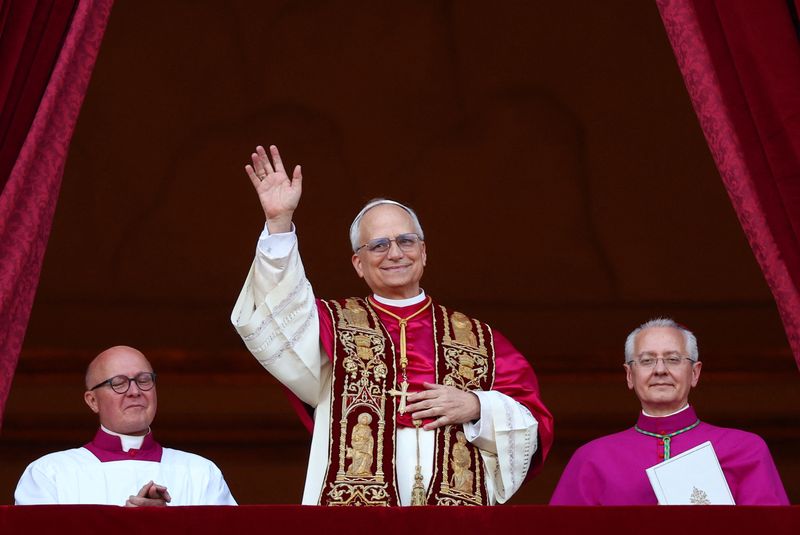
A new Pope has been elected, and Roman Catholics are elated.
The Roman Catholic Church believes that the Rock on which Jesus builds his church was the Apostle Peter, who allegedly was the first Pope or Bishop of Rome. All the subsequent Popes are the so-called spiritual descendants of Peter.
The true church is, therefore, all those who acknowledge the headship of the Pope and belong to the Roman Catholic structure.
Matthew 16:15-18, the Bible passage on which these notions are based, is a very misunderstood passage.
In Roman Catholic doctrine, God’s grace flows from God through the Pope, through the Cardinals, through the Bishops, through the Priests, and then to the congregation via the sacraments. Thus, to be excommunicated from the Roman Catholic Church is to endanger ones immortal soul.
But is this what Jesus meant in Matthew 16:18?
(Jesus) said to them, “But who do you say that I am?” Simon Peter replied, “You are the Christ, the Son of the living God.” And Jesus answered him, “Blessed are you, Simon Bar-Jonah! For flesh and blood has not revealed this to you, but my Father who is in heaven. And I tell you, you are Peter, and on this rock I will build my church, and the gates of hell shall not prevail against it.”
(Matthew 16:15-18)
In v16, Peter identifies Jesus as the Christ, the Promised King from God who would bring salvation to God’s people and judgement on God’s enemies. Jesus accepts the identification and says that Peter’s insight was given by God.
Jesus then talks about the church which he is building.
Jesus says, “You are Peter (petros)” (v18). Peter, of course, knows he is Peter. Why does Jesus say this?
Jesus was playing on words. Petros is the word for an individual rock or stone or small boulder.
Jesus then says, “On this rock (petra) I will build my church”. Petra is the word for a large rocky formation or a rocky fortress. A petra is much, much bigger than a petros.
The massive rock on which Jesus is building his church can be no other than Himself, or to be more precise, the confession that he is God’s promised King (v16).
The verse should read like this: “Peter, you are a small stone. But on this Rock, the confession that I am God’s King, I will build my church!”
This understanding fits in with Peter’s later understanding of the church consisting of people who are “living stones” built on the foundation of Jesus. Cf. 1 Peter 2:4-6
This was also the Apostle Paul’s understanding in Ephesians 2:18-20.
The church universal consists of people from every tribe, nation and tongue that submit to Jesus as King. You don’t need to be part of any religious structure for that to be true. (Although the Bible commend local church membership as supremely helpful to one’s spiritual growth.)
Prevailing Church
Jesus said that “the gates of hell shall not prevail against” (v18) his church.
The original Greek text actually says the “gates of hades will not prevail against it”.
Hades is the place where dead people go to. It’s death. It’s the grave.
Gates are not offensive weapons. You don’t hit people with gates. Gates are defensive. They keep people out or in.
What is in view here is that Death has these huge metaphorical gates that keep people in. No-one escapes death. Death takes you and keeps you. Except that Jesus says that the gates of hades will not prevail or overcome his church.
The church will overcome the gates. Death has no final victory. And Jesus secured and guaranteed that victory when he conquered the Gates of Death when he rose from the dead.
All those who submit to Jesus as King will share in Jesus victory over death. They too will conquer the gates and live forever.
The keys of the kingdom
Then Jesus said something even more controversial.
“I will give you the keys of the kingdom of heaven, and whatever you bind on earth shall be bound in heaven, and whatever you loose on earth shall be loosed in heaven.” (v19)
What are the keys of the kingdom of heaven?
Many people have had various views over the years, but I think the “keys of the kingdom” is simply the gospel.
Whatever your response to the gospel about King Jesus is on earth, that decision is ratified in heaven. If you reject the gospel on earth, that decision is ratified in heaven. But if you believe the gospel on earth, you can be assured that heaven has recorded that decision.
Your response to the gospel does not only have earthly consequences, it has heavenly, eternal consequences.
Jesus, God’s King, is building his death-defeating church. Those who belong to Jesus’ church will live forever with Jesus and the rest of his church in the world to come, even though they die in this world.
However, those who reject Jesus as King and are not part of his church, will experience the great judgement of God.
Why do Evangelicals reject the papacy?
- The Church is not built on the Pope, but on Jesus the Cornerstone and the original Apostles and Prophets (Ephesians 2:20). The Pope needs Jesus just as much as anyone else and is no nearer to God than any other Christian.
- Jesus taught us that Christians have the astounding privilege of addressing God as “Our Father in Heaven, hallowed be your name” (Matthew 6:9). God is our Holy Father. It would be extreme arrogance for anyone else to assume that title.
- The New Testament teaches that through Jesus we have complete and direct access to God. We no longer need middle-men or mediators as in Old Testament times. Jesus is our Great Prophet, Priest and King. (cf. Hebrews 1:1-4)
- The danger in Roman Catholicism is that Catholics think they need the gospel plus something else. That faith alone is not quite enough to save me today and forever. The danger is that they are taught that they need to top up grace via Mass, or Confession, or Penance etc.
- Evangelicals reject the Papacy because it obscures the Bible’s very clear teaching that salvation is by God’s Grace Alone, by Faith Alone, in Christ Alone, to the Glory of God Alone – all this from the authority of Scripture Alone.
The word “alone” is a very small word, but has massive implications.