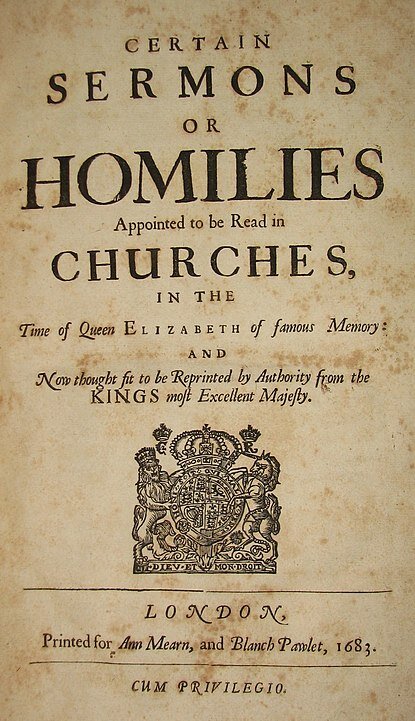
How can we bring the great truths of the Bible, including the glorious doctrine of Justification by Faith Alone, to the people?
This was the question that Archbishop Thomas Cranmer and the other English Reformers asked themselves during the time of the Protestant Reformation of the 1500’s.
The Church of England broke away from the Church of Rome and sought to embrace and proclaim a Reformed, Evangelical Theology.
Churches in England were slowly recovering from the Latin Mass and various other forms of false and extra-biblical Roman Catholic doctrine, like the teachings on Purgatory and Indulgences.
As part of the answer to their question, the English Reformers provided churches with official books of Evangelical sermons known as the “Books of Homilies: Certain Sermons or Homilies Appointed to Be Read in Churches”.
These official sermons were revolutionary in that they were in English, the language of the people, not in the “holy” language of Latin. They were to be read “plainly and distinctly” in correct order on consecutive Sundays. The order of the sermons was important as each sermon laid the groundwork for the next as God’s magnificent gospel was expounded to the congregation.
Remember, the parish priest (minister) could possibly not even name the four Gospel writers, let alone extol the recently rediscovered biblical doctrines of the Reformation. However, if he was somewhat literate, he could at least feed his people by reading a set homily at each service.
The Preface of the First Book of Homilies (published 1547) states its intended purpose:
“These Homilies are set forth also considering the earnest and fervent desire of the King’s dearly beloved subjects to be delivered from all errors and superstitions, and to be truly and faithfully instructed in the very word of God—that lively food of our souls—whereby they may learn unfeignedly and according to the mind of the Holy Spirit expressed in the Scriptures, to honour God and to serve their King with all humility and subjection, and to behave themselves in a godly and honest way towards all…In [this book] is contained certain wholesome and godly exhortations, to move the people to honour and worship Almighty God and diligently to serve him, everyone according to their degree, state, and vocation.”
(Gatiss, Lee. The First Book of Homilies (p. 30). Lost Coin Press for Church Society. Kindle Edition.)
George Whitefield, the famous Anglican minister and Evangelical preacher of the 18th Century, lamented the disuse of these official sermons. He agonized:
“What a pity is it therefore, that this Book of Homilies is not judged proper, and insisted on to be read in churches, by ministers diligently and distinctly, that they may be understood by the people now, as well as at the first dawnings of the Reformation.”
(Gatiss, Lee. The First Book of Homilies (p. 26). Lost Coin Press for Church Society. Kindle Edition.)
The official Anglican Statement of Faith also promotes the use of these official sermons:
“The two books of Homilies, which were set forth in the times of Edward VI and Elizabeth I respectively, contain godly and wholesome teaching.”
(Article 35 of the 39 Articles of Religion)
The homilies contained in the first book are:
- A Fruitful exhortation to the reading of holy Scripture
- Of the misery of all mankind
- Of the salvation of all mankind
- Of the true and lively faith
- Of good works
- Of Christian love and charity
- Against swearing and perjury
- Of the declining from God
- An exhortation against the fear of death
- An exhortation to obedience
- Against whoredom and adultery
- Against strife and contention
In the next couple of weeks, I hope to post a few articles with extracts from the First Book of Homilies to set our hearts ablaze in love for God as we remind ourselves that “we are more sinful and lost than we could ever imagine but also more loved by a merciful God than we could ever dream.” (Lee Gatiss)
I recommend this edition of the First Book of Homilies in modern English.
Any comments or queries can be sent to andre@christchurchtygerberg.org.za