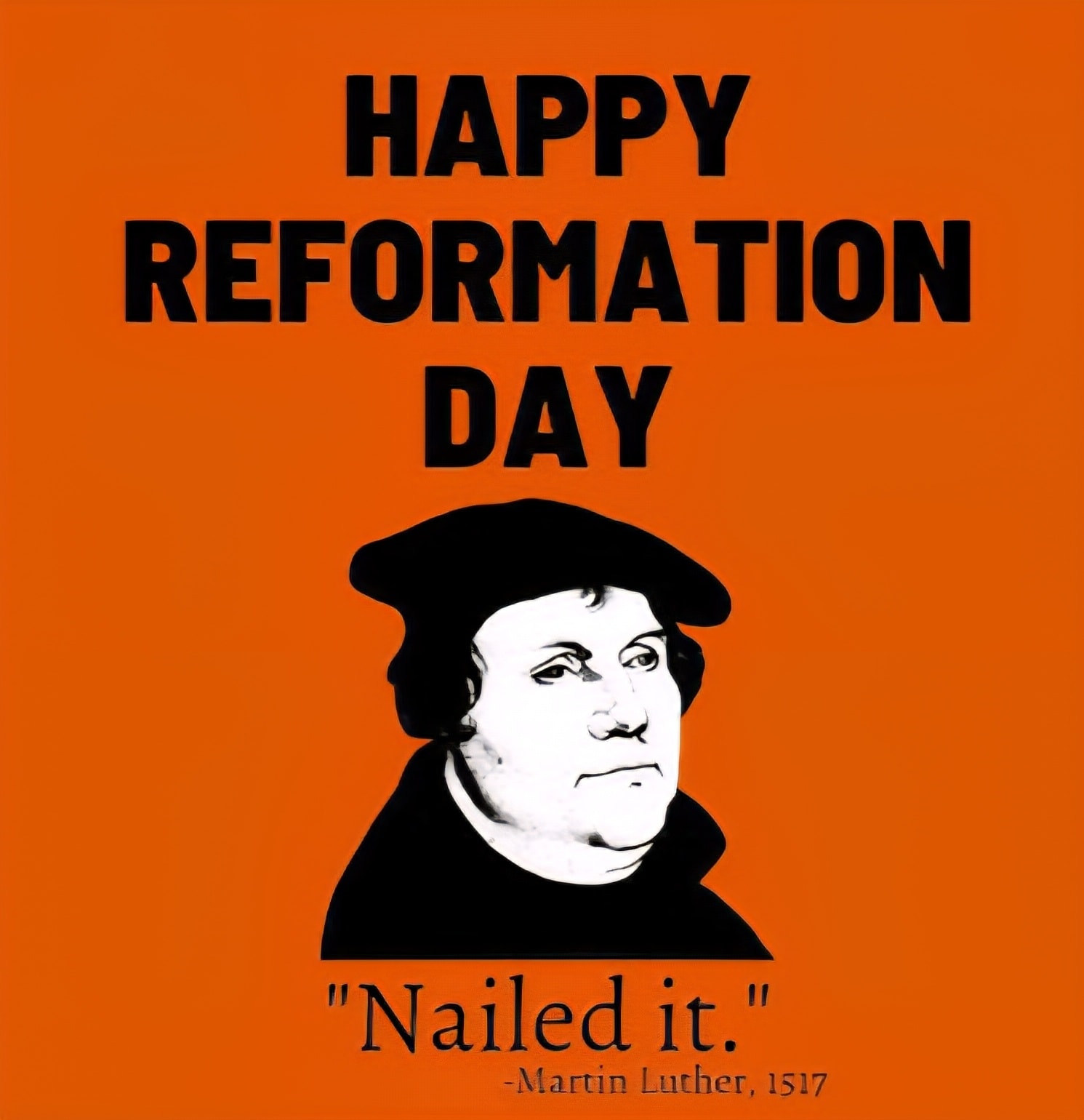
Have you ever wondered: Am I good enough for God? Have I done enough to please God? Are my prayers sincere enough? Is God happy with me? What about my sin? Is God angry with me?
Five hundred years ago, these questions plagued Martin Luther and, in God’s providence, led to the Protestant Reformation.
On 31 October each year, we remember and celebrate, not Halloween, but the Reformation.
The “Dark” Ages
The Middle Ages are often called “Dark Ages” because of its perceived cultural stagnation and intellectual deterioration. However, Protestants also refer to them as the “Dark Ages” because of the growth of spiritual darkness, the loss of biblical clarity, large-scale gospel ignorance, and the rise of religious superstition.
The Roman Catholic Church, centred in Rome, was the dominant church in Christendom and influenced every aspect of people’s lives.
It was taught that the Pope was your Father and the Church was your mother. There was no salvation outside the church. Excommunication meant you were damned to eternal hell.
God’s Grace was dispensed via the Church hierarchy and the sacraments.
In Roman Catholic theology, there are seven sacraments: Baptism, Confirmation, the Eucharist (Mass), Penance, Anointing of the Sick, Holy Orders, and Matrimony. Each serve as a channel of divine grace.
The Priest (as per his title) is the mediator between God and man, and secures sanctifying grace, through the church, for the faithful.
The Roman Catholic Church (RCC) taught Baptismal Regeneration. One received initial sanctifying grace at Baptism – which led anxious parents to baptize their infants as quickly as possible lest they die and be damned to hell.
At Baptism, one entered a state of grace; but persistent sin slowly tarnished, hindered, wounded, and even destroyed sanctifying grace. Yet all was not lost! Through the other six sacraments one could re-enter a state of grace.
The sacrament of the Eucharist (Mass) was the high point.
At the Mass, the priest mysteriously and supernaturally transformed the bread and wine into the body and blood of Christ. It still looked like bread and wine, but in essence it was truly the body blood of Christ. The bread or waver, as the body of Christ, is so holy one can’t touch it with one’s hands; the Priest placed it on the congregant’s tongue.
The blood of Christ is even more holy and precious, so most of the faithful only ate the bread. The blood of Christ was reserved for the priest and other holy church dignitaries.
By merely taking part of the Mass one received sanctifying grace.
Church services, including the Mass, were in the holy language of Latin – a language most people did not understand – but it didn’t matter, the sacrament were “ex opere operato” meaning that the validity of a sacrament did not depend on the faith of the recipient.
At the words of consecration the priest prays, “Hoc est enim Corpus Meum” (For this is my body). Non-Latin speakers simply heard the phrase, “hocus pocus”, which became the word for magic, as it was thought the priest magically transformed the bread and wine.
The best time to die was probably right after being baptized or attending Mass – before you lost sanctifying grace.
But what if you died just before Mass?
If you had committed “mortal” or serious sin, like murder, you were damned to hell because mortal sin destroys sanctifying grace. However, if you simply committed “venial” or lesser sins, you could fortunately be purged or purified, after death, of those sins in purgatory.
The RCC’s doctrine of purgatory enabled believers to become pure enough for heaven despite dying in venial sin.
The doctrine of purgatory was thus originally meant to be a pastorally helpful doctrine as it paved a way for sinners, who died in sin, to (wonderfully) get to heaven. But it became a doctrine that caused anxiety and fear.
The RCC also taught that one could lesson another soul’s time in purgatory through an Indulgence. Fortunately, Christ and the Saints had done more good works that what was required of them. The merit of all those good works is stored in the Treasury of Merit. Through an indulgence, granted for acts of devotion, penance or charity, one could have merit transferred to your loved one in Purgatory. By the 1500’s, one could even purchase Indulgences. It was a spiritual EFT: spiritual blessing for money.
These were just some of the spiritual abuses and doctrinal errors which typified the RCC. Bibles were not available in the language of the people; and the truth of the Gospel was hidden, lost and covered up.
Martin Luther the monk
Martin Luther was born in Germany into this spiritually dark world. He was intelligent, and his parents wanted him to be a lawyer and make lots on money.
The young Luther was on track to be a lawyer but one day Luther was returning to university after visiting his family when he was caught in a violent thunderstorm. Lightning struck near him, throwing him to the ground. In panic, he cried out to St. Anne: “Save me, St. Anne, and I will become a monk!”
He survived, and to his parents dismay he became a strict Roman Catholic monk. He was a very devout monk. He prayed regularly, obeyed the rules, fasted, disciplined his body, wore uncomfortable undergarments and even slept on the floor of his cell. He confessed even the smallest trespasses. All this to somehow please God and build up righteousness.
One exasperated clergyman once told Luther to go away and commit some proper sins to confess!
In later years, Luther wrote that if anybody could be saved by monkery, it would have been him. And yet, in all this Luther remained anxious about his relationship with God.
Had he done enough? Was he repentant enough? Was he sincere enough in his prayers? What about his sins?
One year he had the opportunity to visit Rome itself, the holy headquarters. In Rome, the heart of Christendom, the seeds of doubt began to grow. He visited all the Holy Sites, but religion seemed to be more of a business than a reality.
He decided to climb the “Scala Sancta” (Holy stairs).
These stairs are believed to be the steps Jesus climbed to face Pontius Pilate. Twenty-eight, white, marble steps. According to tradition, these steps were brought to Rome by Saint Helena, the mother of Constantine. Luther climbed the steps, kissing each one and saying the “Our Father” on each step. He was assured that this act of devotion could free the soul of his choice from purgatory. Luther reaches the top and thinks to himself, “I wonder if this is true?”
On his return to Germany, he was transferred to a monastery in Wittenberg where he would teach theology as a professor. He now had more access to the (Latin) Bible, and this was a transfer that Rome would regret. It was at Wittenberg that God used his Word to convert Martin Luther.
The 95 Theses
At Wittenberg, Luther also grew increasingly unhappy with the sale of Indulgences. Luther believed, among other things, that this cheapened the need for repentance.
A travelling friar who sold indulgences, Johan Tetzel, especially infuriated Luther. Tetzel had two famous rhymes:
“As soon as a coin in the coffer rings, the soul from purgatory springs!”
“Place your penny on the drum; the Pearly Gates open and in strolls mum!”
Luther wanted to have a scholarly debate on Indulgences and therefore on 31 October 1517, Martin Luther nailed his 95 Theses (formal title: Disputation on the Power and Efficacy of Indulgences) to the door of the Castle Church in Wittenberg.
This was not meant to be ground-breaking or scandalous. This was like posting your thoughts on the Varsity Notice Board for discussion. Luther was still a loyal Roman Catholic who simply wanted to reform from within an aspect of Catholicism.
Although he wrote the 95 theses in Latin they were soon translated into German by his students. In God’s providence, the Printing Press was recently invented, and the net result was that his 95 Theses were distributed in the thousands. Luther wanted a debate, but it ended with his excommunication.
This was the spark that started the fire of the Protestant Reformation.
Truth on Fire
Luther was still unconverted at this point. Two years after the posting of the 95 Theses does Luther say that he had a conversion experience while studying the book of Romans. The key moment was when he meditated on Romans 1:17,
“For in the gospel the righteousness of God is revealed—a righteousness that is by faith from first to last, just as it is written: “The righteous will live by faith.”” (NIV)
God used this verse to turn on Luther’s spiritual light bulb. Luther wrote years later, “I felt that I was altogether born again and had entered paradise itself through open gates!”
Luther realized that righteousness was not something to be earned through good works, religious endeavour or moral effort, but was a gift received from God through faith in Christ. Righteousness was not the stick that God uses to beat us with; but the right standing with God that God himself gives to all those who put their trust in Christ. This doctrine is known as Justification by Faith, and it undermined the RCC’s teaching that salvation required sacraments and good works.
God’s sanctifying grace is available to anyone who puts their faith in Christ, in or outside the church. The Christian life is not about building righteousness but about accepting God’s gift of righteousness in Christ.
The theology and sacraments of the RCC obscured the gospel instead of teaching and demonstrating it.
The RCC said: “You do your religious bit, and God will do the rest.”
Luther said: “We are dead in our sins and can’t reach out to God. God’s grace alone saves us.”
Luther talked about the “joyful exchange”, where all our sin is counted to Christ and all his righteousness is counted to us by faith.
The result was that Luther was excommunicated as a heretic. But while in hiding for his life, he translated the New Testament into German – the language of the people.
The newly invented Printing Press made sure that ordinary people, for the first time in hundreds of years, where able to read the Bible for themselves. Luther’s ideas spread across Europe, and the Protestant Reformation resulted.
Great Bible truths were rediscovered.
1. Scripture alone is our ultimate authority
Our ultimate authority is not what the Pope or the church says. The Pope and the Councils may be wrong.
Rather than seeing the Pope as Christ’s representative on earth, he saw him as a corrupt leader who had strayed from Biblical Christianity.
2. Salvation is in Christ alone by Grace alone through Faith alone
We are declared right with God through simple trust in Christ, apart from good works or taking the sacraments. We are assured of heaven when we die because our righteousness is from Christ, not ourselves. The doctrine of purgatory is an evil invention.
3. The Priesthood of All Believers
Every and any believer can approach God directly through the merits of Christ – priests were no longer needed. The church did not have the property rights on sanctifying grace. The church was thus no longer in control of salvation.
4. Worship as a response to God’s Grace
The Reformation transformed church and corporate worship.
Worship was no longer me doing something for God to access grace, me responding to God in gratefulness because of God’s grace to me in Christ. Worship was not us doing something for God, but celebrating what God has done for us.
Church was in the language of the people and prominence was given to Bible reading and the sermon.
Rather that listening to choirs, people sang good theological hymns to praise God and remind themselves of truth. Luther pioneered this by writing many wonderful hymns, including, “A Mighty Fortress is our God”.
5. Assurance of Salvation
I no longer needed to be anxious because I knew my eternal salvation did not depend on my goodness, but God’s faithfulness. My eternal salvation was therefore secure.
Martin Luther is known as “God’s Volcano”.
He preached, wrote, debated, authored hymns, translated the New Testament, and more. And yet Luther said, “I did nothing; God’s Word did everything.”
Modern Day Challenges
1. Roman Catholic Theology
Sadly, the spiritual abuses and Biblical errors of the Roman Catholic Church are still with us.
Just last year, the Vatican issued a decree outlining the many ways Catholics can obtain an indulgence during the 2025 Jubilee Year. Indulgences, accessing the Treasury of Merit for souls in Purgatory, is still the official teaching of the RCC.
So too thee teaching on Baptismal Regeneration, The Mass, the Cult of Saints and many other doctrines repugnant to Scripture.
2. “Man of God” theology
The Hierarchical Authority view, where the priest is closer to God and my mediator, is rampant in modern, Pentecostal “Man of God” theology.
The so-called Man of God, or Apostle, or Prophet, is seen as on a higher spiritual level than me, so I go to him for spiritual blessing. Often that blessing costs money.
Church is not corporately responding to God’s grace and listening to the God’s Word (the Bible) but watching the “Man of God” do his magic in front. Church has, once again, become a spectator sport.
3. Biblical illiteracy
We may have numerous Bibles in our own language, but many people don’t read them or take them to church. Christians often believe what the pastor says, without checking in their Bible to confirm if what the pastor says is indeed correct and true.
4. The power of God’s Word
Many churches do not rely on the power of God’s Word to grow the church. Many churches rely on gimmicks, personalities, new “insights”, and entertainment to grow. The Reformation was a call back to the sufficiency and power of God’s Word to build God’s Church and edify God’s people.
The net result is that, theologically, many people still live in the Dark Ages.
We need to constantly relearn and reapply the lessons of the Reformation to ourselves and our churches.