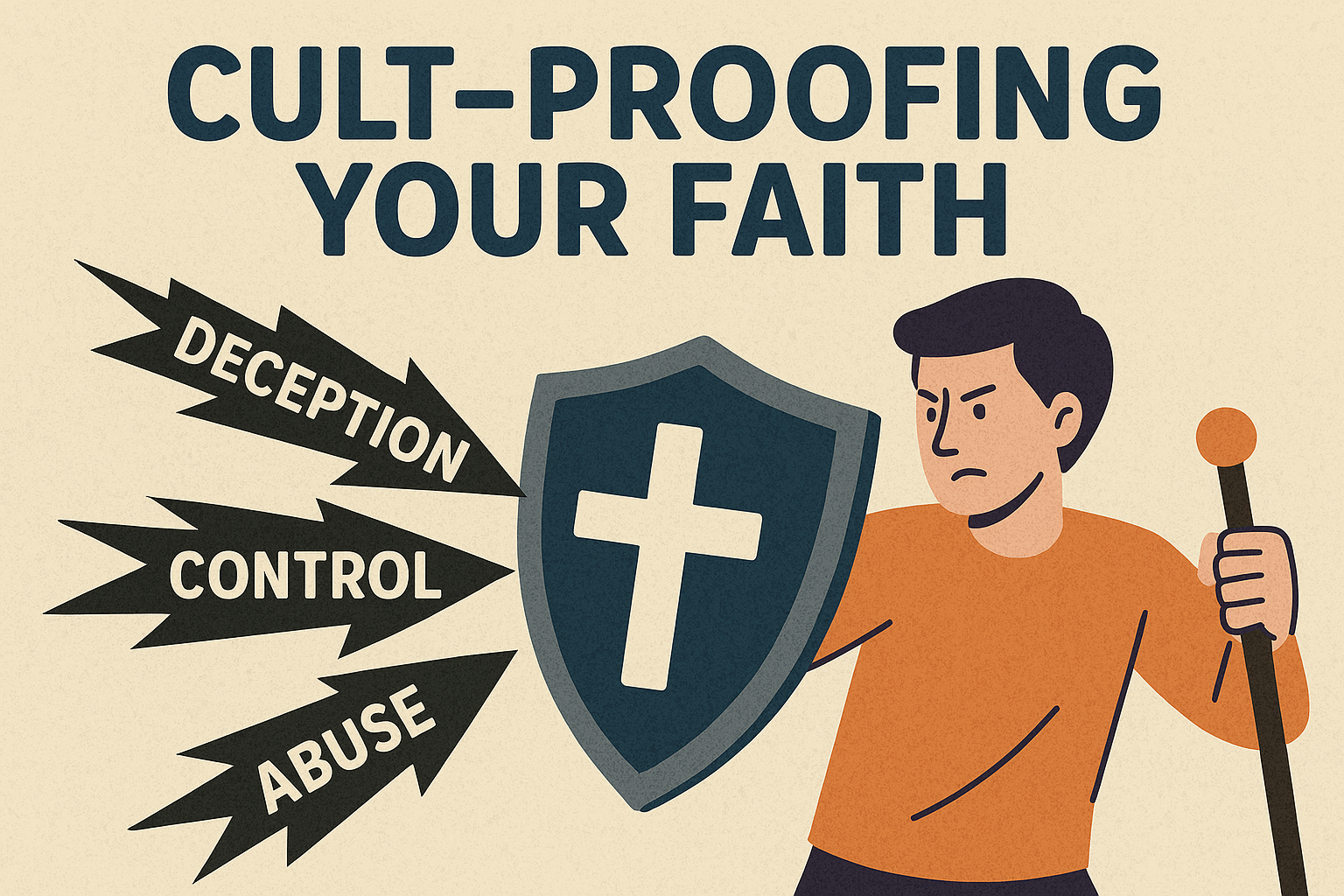
The second half of the Homily on the Christian’s good works warns of the bad works of false religion.
Thomas Cranmer, the author of this fiery sermon, warns the congregations to beware of the bad work of elevating human tradition and man-made rules above God’s word.
The sermon must have caused quite a stir as England was in the process of leaving Roman Catholicism with its elevation of extra-biblical doctrines and practises, and embracing a Reformed, Protestant faith.
Today, as in medieval times, there are many denominations, churches, ministries and pastors that purport to be “Biblical” and “Christian”. Just like in those days, many of these organisation and leaders are in fact promoting false religion, human traditions and erroneous beliefs; often operating more like a cult than a Christian organisation or church.
Sin leads to idolatry
The sermon contends that as humans we are prone to forsake God’s Word for all kinds of alternate, more “acceptable” views.
“People’s blindness and malice, even from the beginning, has always been ready to fall from God’s commandments…that they have always been ready to fall from God and his law, and to invent a new way to salvation by works of their own devising.”
Human traditions
The sermon goes on to list the various false gods and idols that people worshipped throughout Old and New Testament times. The sermon states that those who teach an extra-biblical religion are in fact the furthest away from God:
“Besides these inventions already mentioned, people’s inclination to have their own holy devotions devised new sects and religious groups, called Pharisees, Sadducees, and Scribes. They had many holy and godly traditions and ordinances (as it seemed by the outward appearance, and the great glistening of their works), but in fact they all tended to idolatry, superstition, and hypocrisy…For despite all their great traditions and outward shows of good works, devised by their own imagination, by which they appeared to the world as the most religious and holy people, Christ (who saw their hearts) knew that they were inwardly, in the sight of God, most unholy, most abominable, and the furthest away from God of all people.”
“It is common with such traditions that they lead to the transgression or breaking of God’s commandments, and to more devotion in keeping the traditions and a greater conscience about breaking them, than concern for the commandments of God.”
“And therefore, Christ called them blind guides, warning his disciples from time to time to avoid their doctrine (Matthew 23:24). For although they seemed to the world to be most perfect people, both in living and teaching, yet their life was but hypocrisy, and their doctrine sour yeast, mingled with superstition, idolatry, and preposterous judgment, setting up human traditions and ordinances, in place of God’s commandments.”
Obedience, Chastity and Imposed Poverty
Cranmer highlighted three big areas of human tradition and superstition promoted by the Roman Catholic church: obedience (to the Pope), chastity (celibacy imposed on religious leaders) and wilful poverty.
“By professing who they were not bound to obey, they forsook their due obedience.”
The sermon thus condemns the command to obey the Pope which superseded other legitimate calls to obedience e.g. government, local authorities & parents.
A characteristic of cults is that they also demand unqualified obedience to human leaders. Obedience that it often in conflict with legitimate calls to obedience in the Bible.
Concerning the compulsory vow of celibacy in the priesthood and other religious orders, Cranmer was too embarrassed to go into any detail. He simply wrote, “It would be better to pass over in silence how their profession of chastity was kept, and let the world judge of that which is well known, rather than with unchaste words to express their unchaste life, and therefore offend chaste and godly ears.”
Unfortunately, and tragically, it was and is not an uncommon practise in religious organisations, particularly in cults, that religious leaders sexually manipulate and exploit those in their “care”.
Imposed poverty was the third area of difficulty for Cranmer.
“When they had possessions, jewels, plate, and riches they were equal or above merchants, gentlemen, Barons, Earls, and Dukes. Yet by this subtle term of sophistry, proprium in commune, that is to say, proper in common, they mocked the world, claiming that despite all their possessions and riches they were keeping their vow, and were in wilful poverty. But for all their riches, they might never help father nor mother, nor others who were indeed very needy and poor, without the permission of their father Abbot, Prior, or Warden. They might take from anyone, but they should not give anything to anyone, no not even to those whom the laws of God bound them to help. And so through their traditions and rules, they resisted the laws of God.”
The medieval Roman Catholic Church amassed great wealth often at the expense of the poor and devoted.
Many religious organisations do the same today. The untouchable leaders live in huge houses, fly first class, wear designer clothes and are largely inaccessible and unaccountable. Meanwhile, those in their churches are struggling to make ends meet and balance their budgets.
The attitude of “Rules for thee and not for me” is especially true of these leaders. The leadership may require compulsory giving by members and the handover of assets, while they themselves live in luxury.
Cranmer’s summing up of the Roman Catholic church’s higher regard for human tradition than God’s Word applies to many churches, ministries and ministers today,
“The laws of God were also partly left aside, and less esteemed, so that these laws, decrees, and councils with their traditions and ceremonies might be more duly kept, and had in greater reverence.”
Cult-Proofing
How then does one cult-proof one’s faith? Cranmer would ask you to answer the following questions about your church:
- Do they require you to obey the leaders of the organisation?
- Do they require more obedience and rules that what the Bible instructs?
- Do the leaders have a different set of standards to the rest of the church?
- Do the leaders use and exploit people, rather than living a godly, above-reproach, Christ-like lifestyle of serving others?
- Do the leaders require you to give sacrificially while they live at an extremely high standard?
- Do the leaders lack transparency about the allocation of church money?
- Do the leaders fail to keep a close watch on their life and doctrine? cf. 1 Timothy 4:16
If you can say yes to any of these questions, you may be part of a church that is deviating from the Bible or, worst-case scenario, a cult.
The Bible’s advice to those who are part of a deviating church, or a cult is: leave. Cf. Romans 16:17.
Towards the end of the homily are these words which should be our constant, heartfelt prayer:
“God grant all of us…to feed on the sweet and savoury bread of God’s own word, and (as Christ commanded) to avoid all Pharisaical yeast of human false religion.”
***
All extracts are taken from: Gatiss, Lee. The First Book of Homilies: The Church of England’s Official Sermons in Modern English. Lost Coin Press for Church Society. Kindle Edition.
Any comments or queries can be sent to andre@christchurchtygerberg.org.za